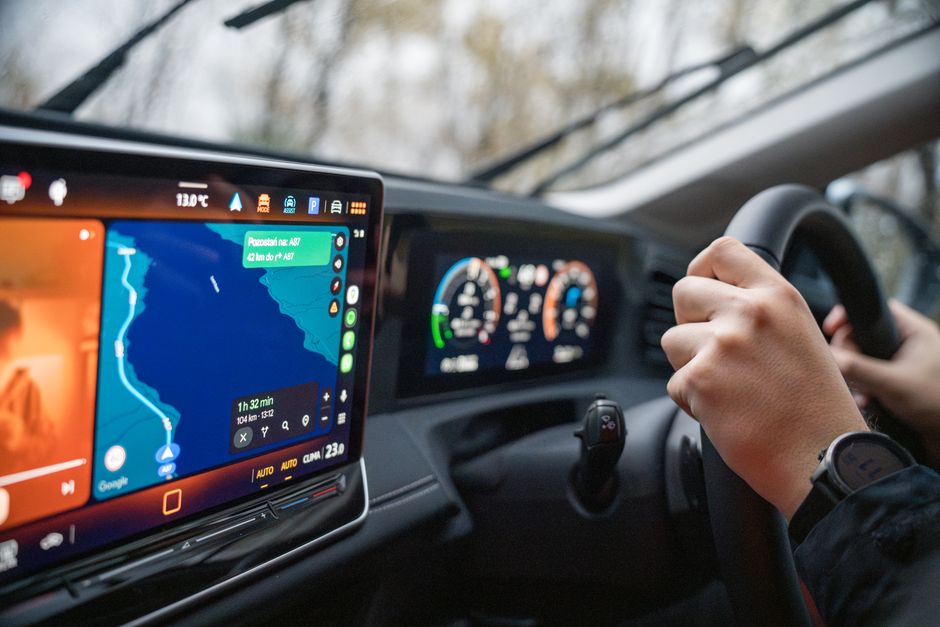
Most of the pitches for an AI assistant that knows your email have felt like solutions in search of a problem. On a phone, I can open Gmail and find my flight confirmation in about four seconds. Asking a chatbot to do it for me saves almost nothing.
In a car, those four seconds are the problem. That’s why Google’s decision to bring Personal Intelligence to Gemini in Android Auto is the most sensible deployment of the feature so far.
What actually shipped
Starting today, Gemini in Android Auto can draw on your data across Gmail, Calendar, Maps, Photos, YouTube and Search history. Cars with Google built-in get the same upgrade “in the coming months.” Google’s examples are deliberately mundane:
- Ask for your flight status on the way to the airport, and Gemini pulls the flight details from a confirmation email and checks them.
- Say “take me to my doctor’s appointment” and it finds the address in your calendar.
- Ask it to “find the car wash from the photo I took last week and navigate there.”
TechCrunch notes that you can stack follow-ups in natural language, asking for your gate and then whether the flight is still on time, and Gemini will answer both together.
This builds on a fast rollout. Gemini reached Android Auto last November and cars with Google built-in in April, and Personal Intelligence itself went to all US users in March. Ford, GM, Honda, Nissan, Volvo and Polestar all ship cars with Google built-in, so the eventual reach here is large.
Why the car is the right venue
Voice assistants have always been strongest when your hands and eyes are busy. The weak point was that they knew nothing about you. “Navigate to my appointment” meant nothing to old Google Assistant unless the event had a perfectly formatted address. Connecting the assistant to the places where that information actually lives fixes the most annoying gap in in-car voice control.
The photo example is the one I’d watch. Calendar lookups are structured data. Finding a car wash from a picture means Gemini has to recognize a location from an image, match it to a place, and hand it to Maps without you ever touching the screen. If that works reliably, it’s a real agent task done in a context where you can’t babysit the result.
That reliability is where my enthusiasm stops short of trust. A wrong answer on your phone costs you a re-prompt. A wrong destination on the highway costs you a missed exit and a distracted driver poking at a screen. Google hasn’t said anything about how Gemini handles ambiguity, like two appointments on the same day or three car wash photos.
The privacy setup is better than expected
Personal Intelligence is opt-in, you can choose which apps to connect, and you can switch it off anytime. The smartest detail is easy to miss: personalized responses only happen when your phone is connected to the car. In a car with Google built-in, that ties your data to your device, not the vehicle. It matters for anyone who shares a car or hands keys to a valet.
Google is also careful to say that skipping the feature costs you nothing basic. “If you don’t use Personal Intelligence, everything in the car still works,” the company says. Navigation, music, calls and general questions just won’t be tailored.
The unanswered bit is what happens when two people with Personal Intelligence enabled both have their phones connected, and the passenger asks Gemini where the next appointment is.