Nvidia posted $96.2 billion in revenue last quarter and told investors to expect roughly $108 billion in the current one. That would put it in a club with Amazon, Apple, and Alphabet, companies that reached $100 billion a quarter by selling to everyone on earth. Nvidia is getting there by selling to maybe a few dozen serious buyers.
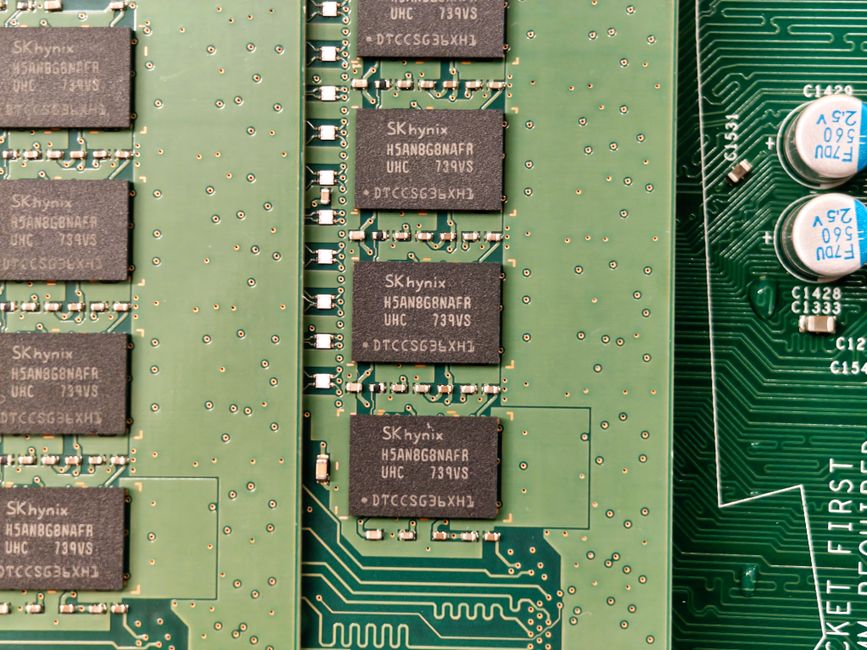
Jensen Huang says AI “has reached its inflection point.” Executives say things like that every quarter. The number that actually costs Nvidia something is the purchasing side: up to $160 billion committed to memory, pushing total supply commitments to $279 billion.
Commitments are a bet, not a forecast
Revenue guidance is a prediction. A purchase commitment is a signature. Nvidia has now signed for nearly three quarters’ worth of revenue in components, and the bulk of it is high-bandwidth memory, the part of an AI accelerator that has been the actual bottleneck for two years running. You don’t lock in that volume unless you believe the order book holds through the delivery window. You also can’t unlock it if you’re wrong.
That is the interesting asymmetry. If demand keeps climbing, Nvidia has pre-empted the supply crunch and its competitors get whatever HBM is left over, at whatever price the shortage sets. If demand softens even modestly, Nvidia is holding contracts for memory it planned to solder onto boards nobody ordered.
Everyone else pays for this
Memory fabs don’t spin up new capacity on a quarterly cadence. When one buyer reserves $160 billion of output, that capacity is gone from the pool everyone else draws from. Consumer DRAM, GPU VRAM, phone memory, server RAM for workloads that have nothing to do with AI, all of it competes for wafer starts against a customer with a bigger checkbook and a longer time horizon.
Anyone shopping for a graphics card or a RAM kit in the next year should read the $160 billion figure as a price signal aimed directly at them. Nvidia’s gaming division has spent this cycle as a rounding error next to data center, and the company’s own supply decisions now make consumer parts more expensive to build.
The concentration problem nobody wants to name
Amazon hit $100 billion a quarter on the backs of hundreds of millions of shoppers. Nvidia’s path runs through a handful of hyperscalers and AI labs, most of whom are burning investor money rather than operating profit, and several of whom are actively designing chips to stop buying from Nvidia.
Those customers can also change their minds fast. A capex plan is a slide in a board deck; it can be revised in an afternoon. Nvidia’s memory contracts cannot.
So the milestone is real and it will probably land. The question is what $279 billion in commitments looks like on the balance sheet if the current quarter is the peak rather than the floor. Nvidia has bet, in writing, that it isn’t.